

I’ve visited Santiago de Compostela three times now. Once when I walked the Camino Primitivo; once when I walked the Camino Finisterre; and once when I walked the Camino Portugués. I fell in love with the city on my first afternoon there, and when I returned the following year, it felt like coming home.
Although I think it’s fair to say that a large percentage of people you’ll rub shoulders with in the city are either just finishing or have recently finished walking one of the Camino de Santiago hiking trails, there are plenty of things to do in Santiago de Compostela that are not connected to walking or religion.
Most of all, it’s beautiful city, with some stunning architecture, interesting museums, quality dining options (whether you want breakfast, brunch, pinchos, tapas or a full sit-down meal) and a vast array of parks and green spaces. In fact, you don’t have to walk very far at all to escape the crowds that throng Santiago’s old town streets.
In this guide, I’ll share some of the best things to do in Santiago de Compostela, along with practical information about how to get to the city, and a few recommendations regarding where to stay and where to eat while you’re there.
Some of the links in this post are affiliate links. All this means is that if you make a purchase through one of the links I have provided, I will earn a small commission as a result but the cost to you will remain exactly the same.
Things to Do in Santiago de Compostela
1 | Head to Praza do Obradoiro
If you’re walking one of the Camino de Santiago routes, you won’t need to head here, as this is where your walk will terminate — right in front of the city’s impressive cathedral. Praza do Obradoiro is the beating heart of Santiago de Compostela, and the spot where the stonemasons who carved the cathedral’s facade once worked — hence its name, whose English translation is ‘Square of the Workshop.’
Unless you arrive here incredibly early in the day, you’ll find a constant stream of people in Praza do Obradoiro — either passing through, relaxing, or posing for photographs in front of the cathedral. It’s part of the square’s appeal.
Aside from the cathedral, Praza do Obradoiro is bordered by the Pazo de Raxoi (a beautiful Neoclassical building that houses the City Hall and presidency of the Regional Government of Galicia) and the Hostal dos Reis Catolicos, once a pilgrim hospital and today a Parador hotel. If you fancy staying in Spain’s oldest hotel, don’t let its 5-star status put you off: you can actually score some decently-priced rooms here if you stay mid-week and off-season.

Grand entrance to the Parador Hotel, Santiago de Compostela
2 | Visit the cathedral and take a rooftop tour
Santiago de Compostela’s cathedral is traditionally believed to house the tomb of Saint James the Great (one of Jesus’ 12 apostles), and is one of Christianity’s most important pilgrimage sites. It’s a stunning building and I never tire of walking into Praza do Obradoiro and gazing up at it.
Construction of the cathedral began in 1075 (during the reign of King Alfonso VI), but wasn’t completed until somewhere around 1211. So, the finished structure, whilst primarily built in Romanesque style, also has elements of Gothic and Baroque. It gained UNESCO World Heriitage status in 1985.

The cathedral in Santiago de Compostela (the end point of the Camino Primitivo route) bathed in the golden light of the late afternoon sun.
Entry to the main cathedral (nave, high altar, and Apostle’s crypt) is free and is open daily between 07:00-21:00 hours, but there is an extra charge if you want to visit the museum and the Pórtico de la Gloria.
If you have time (and the available budget; the current cost is €12 for pilgrims), I’d recommend booking a rooftop tour of the cathedral too (‘Cubiertas y Torre de la Carraca’ on the website). It gives you a totally different perspective of the cathedral’s exterior, as well as rewarding you with some spectacular city views.

Views of Santiago de Compostela from the rooftops of its cathedral.
3 | Listen to the bagpipes
You may be forgiven for thinking you’ve momentarily been transported to Scotland as you walk under the archway connecting Praza do Obradoiro to Praza da Inmaculada. However, the bagpipes (known as ‘gaita’ over here) actually arrived in Galicia long before they made it to Scotland.

Bagpipe players regularly serenade pilgrims as they arrive into Praza do Obradoiro, Santiago de Compostela
Bagpipes have been present in Galicia since the 9th century and are an intrinsic part of traditional Galician music and cultural identity. There’s actually a large section dedicated to the Galician gaita in the museum listed below.
4 | Learn about Galician History and Culture at the Museo de Poblo Gallego

Museo do Pobo Galego, Santiago de Compostela
Housed in a convent founded in the 13th century, Santiago’s Museo do Pobo Galego is the city’s museum of Galician history and culture. It documents Galician music history, festivals, arts, crafts, architecture and daily life over the centuries, and is an absolutely fascinating place.

Museo do Pobo Galego, Santiago de Compostela
Good to know: The Museo do Pobo Galego is open Tuesday-Saturday from 11:00-18:00 hours and on Sunday from 11:00-14:00 hours. The admission fee is €4 (correct, November 2026).
5 | Take a relaxing wander around Parque de San Domingos de Bonaval
This is one of my favourite things to do in Santiago de Compostela. Every time I arrive in the city, it’s the first place I head.
Santiago’s Parque de San Domingos de Bonaval is located just northeast of the city’s historic centre and access is around the back of the Museo do Pobo Galego — just walk up the road to the left of the entrance and you’ll see some stone steps on your right that lead up to the park.
Formerly the estate of a convent, the park is now a beautifully green and tranquil retreat from the city bustle not far away.

Parque de San Domingos de Bonaval, Santiago de Compostela.
Unlike Alameda Park (more on that next), Parque de San Domingos de Bonaval is never over-run with people. In fact, every time I’ve visited, I could probably have counted the total number of other people I encountered on two hands. I suspect that, due to its slightly hidden location, Parque de San Domingos de Bonaval is more of a local hangout rather than a tourist attraction.
You can actually walk a full circuit of the park and exit via the entrance to the cemetery. This will bring you out on to Rua de Bonaval and if you hang a right here, you’ll end up back where you started. Don’t forget to pop into the Convento de San Domingos de Bonaval before you leave the area.

Convento de San Domingos de Bonaval, Santiago de Compostela
6 | Be treated to some of the best views of the cathedral at Alameda Park
On the opposite side of the old town to the Museo do Pobo Galego is Alameda Park. Whilst it’s a lot busier than the gardens mentioned above, it’s also a lot bigger (85,000 square metres compared to Bonaval’s 37,000), so it’s still possible to find those quieter corners.

Alameda Park, santiago de Compostela
There are two main reasons why tourists flock to Alameda Park: the famous cathedral viewpoint (marked here on Google Maps) and the statue of Las Dos Marias.
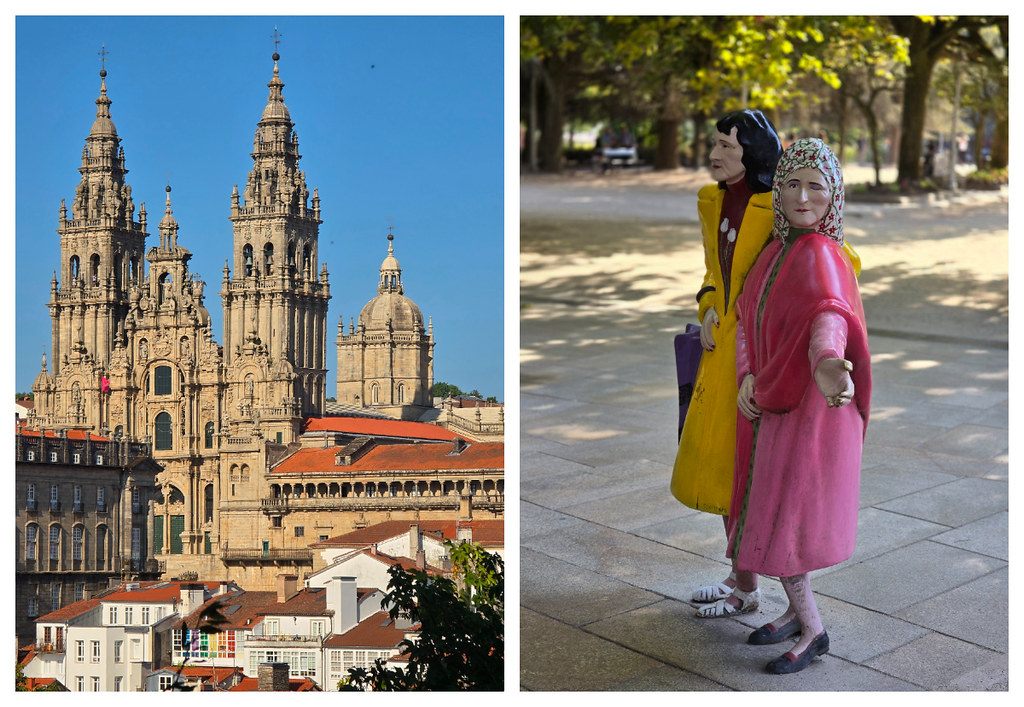
Alameda Park offers some of the best views of the cathedral. It’s also where you’ll find the famous sculpture of the Two Marias
Commonly known as the Two Marías (Galician: as dúas Marías), Maruxa Fandiño Ricart and Coralia Fandiño Ricart were two Spanish sisters who became popular figures in the city of Santiago de Compostela during the years of the Francoist dictatorship. From the 1950s to the late 1970s, they took daily strolls through Santiago’s old town, dressed in colourful, eccentric clothing and flirting with the young students. It was in direct contrast to the social repression of the disctatorship, and as such, these women became local icons.
Spanish scultor and author, César Lombera didn’t want their story to fade into obscurity, so he persuaded the mayor to allow him to install a sculpture in their memory. This sculpture has been a feature of Alameda Park since 1994. You’ll find the sisters just inside the main entrance opposite Rua da Porta Faxeira.
7 | Let your curiosity guide you on a photo-taking walk around the city’s historic centre
Much of the joy of visiting Santiago de Compostela comes from simply wandering through its historic centre, following narrow streets into attractive squares and seeing what you stumble across along the way.
The entire old town was awarded UNESCO World Heritage status in 1985, recognised for both its wealth of historic and religious monuments and its remarkably well-preserved architecture, spanning Romanesque, Gothic, Renaissance, Baroque and Neoclassical styles.

A photo-taking wander around the historic streets of Santiago de Compostela’s old town.
Notable buildings you’ll likely pass include the following:
- Igelesia de San Martin Pinario (middle left on the photo above).
- Convento de San Francisco de Asis.
- Hospedaría de Martiño Pinario (middle right on the photo above; a former 16th century monastery that’s now a hotel).
- Capella das Ánimas (bottom right on the photo above).
8 | Make the climb up to the Convent of Santa María de Belvís
I only actually discovered this place on my second visit to Santiago de Compostela. I was wandering around the periphery of the old town and spotted this place in the distance, at the end of a very long, straight road that descended sharply along Rua das Trompas, passed through a park, and then ascended equally as sharply up to what I later identified on my map as being the Convent of Santa María de Belvís.

Convent of Santa María de Belvís, Santiago de Compostela
If you don’t mind a few stairs, take a right opposite the entrance to the car park and walk through a gap in the wall — the climb up through the park is a lot more scenic than continung along the road.

I loved my peaceful walk through Belvis Park and up to the Convent of Santa María de Belvís, Santiago de Compostela
Founded at the beginning of the 14th century by the Friars of Bonaval, it was the first convent of the Order of Dominican nuns in Galicia. Today, several nuns still live and work in the building, and have earned themselves a bit of a reputation for the desserts they make. I’d read that you could buy these desserts from the nuns themselves during the opening hours of the convent, however, on both occasions I wandered up here, sadly, I saw no sign of the nuns or their desserts.
9 | Get your art fix at the Galician Contemporary Art Centre
Designed by Portuguese architect Álvaro Siza and opened in 1993, the Galician Contemporary Art Centre is located right next door to the Museo do Pobo Gallego and the Parque de San Domingos de Bonaval. So, you can tick this art centre, and the neighbouring museum and park off your list in a morning or afternoon.

the Galician Contemporary Art Centre, Santiago de Compostela
The exhibitions are spread over three floors (one underground and two above), and there is also an outside terrace and sculpture garden.
It’s open Tuesday-Sunday from 11:00-20:00 hours. Admission is free.
10 | Explore the city’s lesser known parks outside the historic centre
On my first visit to Santiago de Compostela, when I checked into Os Sobriños Do Pai after finishing the Camino Primitivo, I found a map in my room. On this map were several marked walking routes, one of which circumnavigated the historic centre and took me through some quieter parks and gardens on the outskirts of the old town.
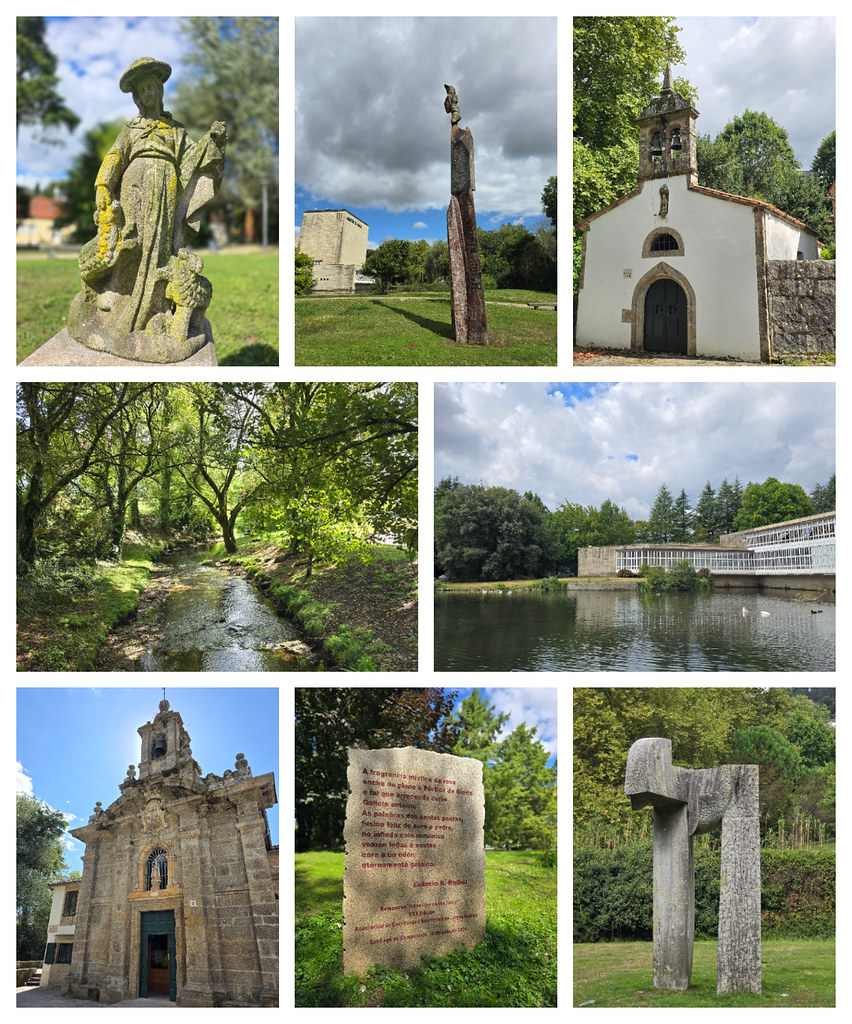
Scenes from some of the beautiful, tranquil parks and gardens outside of Santiago de Compostela’s historic centre.
I absolutely loved this walk and wish I’d taken a photograph of the route, so that I could map it on my Footpath app and share it with you.
As it was, I only thought about this once I’d checked out of my room. But, I have been able to check my photos for geotags, so I’ll share the names of the parks with you below.
- Parque Avenida Burgo das Nacións
- Parque da Música en Compostela
- Parque de Vista Alegre
- Parque de Galeras
- Parque do Carme de Abaixo

Parque de Vista Alegre, Santiago de Compostela
11 | Shop for gifts and souvenirs
If there’s one thing that Santiago de Compostela isn’t short of (other than cafes and tapas bars), it’s shops.
And, whilst you will find many selling very similar Camino-inspired paraphernalia that probably won’t be of interest to you unless you’ve walked one of the Camino routes, there are some wonderful, quality gift shops too. Beautiful ceramics, quality pieces of art work and unusual jewellery are all available in abundance in Santiago de Compostela.

Some of the beautiful gifts and souvenirs available from the shops in Santiago de Compostela
12 | Take a day trip to the end of the world
Cape Finisterre was historically considered the westernmost point of the known world — hence its name, ‘Finisterre’, which literally translates to ‘the end of the world.’
It’s the official end point of the Camino Finisterre, but can also be visited as a day trip from Santiago de Compostela.
Whilst there are certainly enough things to do in Santiago de Compostela to keep you entertained for a good few days, a day spent on the coast provides a good contrast to the hustle and bustle of city life.

Scenes from Finisterre – the end point of the Camino Finisterre
Depending on which bus you catch and which route it follows, it takes an average of two hours and thirty minutes to get to Finisterre. You can search timetables and prices with MoBT or Flixbus.
There’s not really a great deal to do in the town itself, and if you want to be able to say you’ve walked to the end of the world (but don’t have the time or inclination to walk the whole Camino Finisterre trail), I’d recommend making the (relatively) short walk to the lighthouse.
It’s 3.2 kilometres from the town to the lighthouse along the road. Or, there is an alternative route which is notably more difficult (due to the climb involved) and a little longer, but a whole load more beautiful.

Taking the alternative route from Finisterre to the lighthouse via A Insua
If you feel that you’re fit enough to do so, I’d recommend following the alternative trail to the lighthouse and then walking back to town along the road. This circular route is 7.2 kilometres (4.5 miles) long with 224 metres of elevation gain (all in the first half).
Things to do in Santiago de Compostela | Where to Stay
I’ve actually stayed at three different places in Santiago de Compostela. I found a new favourite on my most recent trip to the city, but would still happily stay at either of the other two as well.
All three of these places have private rooms with private bathrooms, are located within a 5-minute walk from the cathedral and will cost you under £70 / €82 per night (correct at time of writing).
1 | Hospedaje Ramos | Calle Da Raiña, No. 18, 3.
Let’s start with my new favourite. I booked a room here when I walked the Camino Portuguese, simply because Os Sobriños Do Pai and Deniké Grupo Atalaia had no availability for the night I needed to stay. Not only was it cheaper than the other two (£45 / €52.75), but it was also nicer — especially the incredible view from my bedroom window!
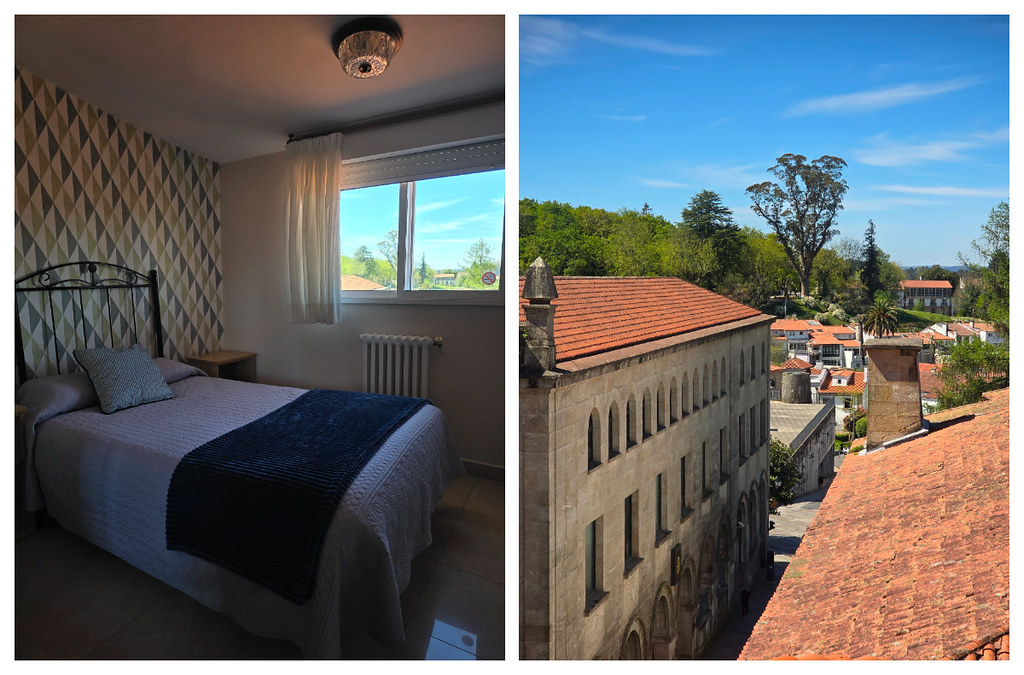
My room at Hospedaje Ramos and the view from my window.
It’s located on a busy street lined with tapas bars and restaurants, but I had a room on the back and found it lovely and quiet to sleep at night.
2 | Os Sobriños Do Pai | Fuente de San Miguel 7.
This is the first place I ever stayed in Santiago de Compostela. I chose Os Sobriños Do Pai for its affordable nightly rate, excellent ratings, and perfect location, and whilst it no longer comes out top trumps on those three factors (Hospedaje Ramos now beats it), it’s still a reliable and affordable place to stay in Santiago de Compostela.
Their single rooms are a little on the small side (for my initial stay, I was lucky enough to be upgraded to one of their more spacious attic rooms), but are perfectly adequate for a short stay in the city.
Rooms are located above a popular Galician restaurant that’s famous for its ‘pulpo’ (octopus). Although I didn’t eat there, it looks lovely and cosy and gets some great reviews.
3 | Deniké Grupo Atalaia | Porto da Pena 4.
Denike is a little pricier than the other two on my list, but it does have a slightly more luxurious feel as a result. And a stay here, even during the popular summer months, can still come in at under £70 (€83.49) a night — I paid £66 (€78.72) at the end of August.
A buffet breakfast is available (for an additional cost) in the dining area on the ground floor, where there are also free coffee and tea-making facilities for guests.
You’ll find Denike on the same street as one of my favourite cafes in Santiago de Compostela (Costa Vella) and also one of my favourite city viewpoints.

Things to do in Santiago de Compostela | Where to Eat and Drink
Coffee, Breakfast and Brunch
1 | Café Tertulia | Rua Pombal 2
One of my favourite places for breakfast in Santiago de Compostela, Café Tertulia is friendly, welcoming spot, with a good choice of coffees, teas and breakfast items at really affordable prices. It’s far enough away from the main historic centre to feel like a proper little local spot, whilst still being under a kilometre from the city’s cathedral.
If you’re walking the Camino Finisterre, this is a great place to stop for breakfast on your way out of the city as it’s right on the trail and opens as early as 7:15 a.m. during the week (although, they’re closed on Mondays) and 8 a.m at the weekend.
I love the smoked salmon, cream cheese and rocket tostadas.

Breakfast at Café Tertulia, Santiago de Compostela
2 | Costa Vella | Rúa da Porta da Pena, 17
If you’re looking for the most Instagrammable cafe in Santiago then Costa Vella wins hands down! There’s a lovely, large, lush and colourful garden out the back, with lots of shaded seating areas, an array of plants and flowers, a water feature, and some artwork and sculptures — all backed by some distant views of the city’s beautiful cathedral.
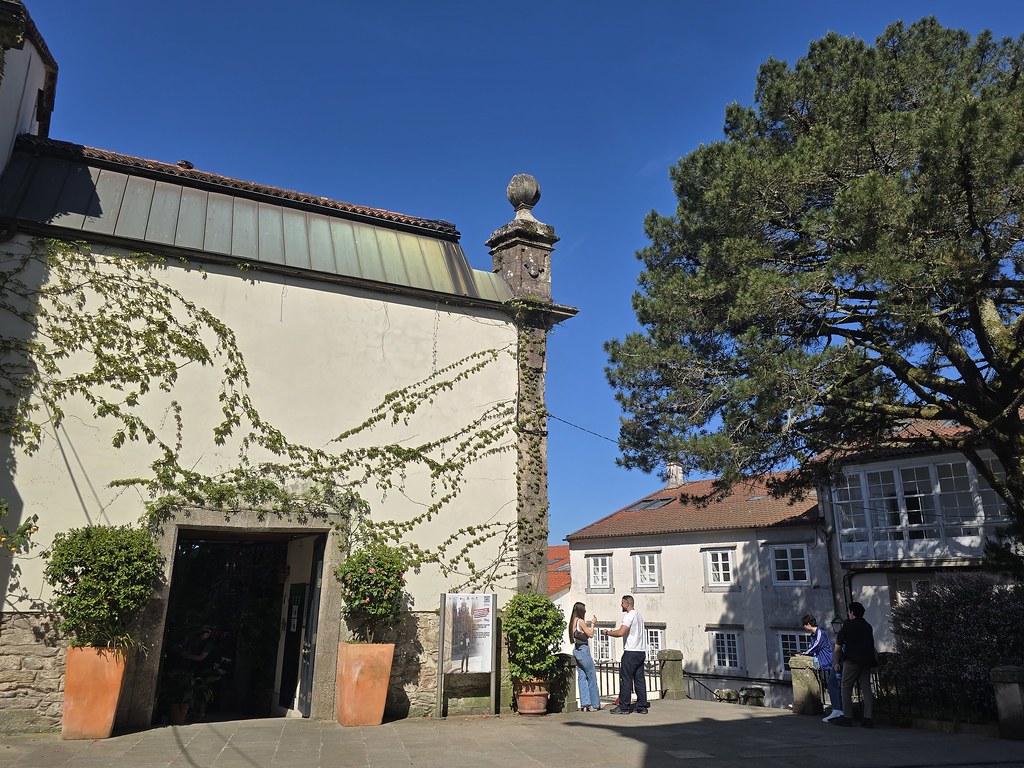
The exterior of Costa Vella – one of the most Instagrammable cafes in Santiago de Compostela.
It’s a little hidden corner of peace and tranquillity in the heart of the city, a place that invites reflection and inspires creativity. Somewhere you can comfortably linger for hours, surrounded by nature.
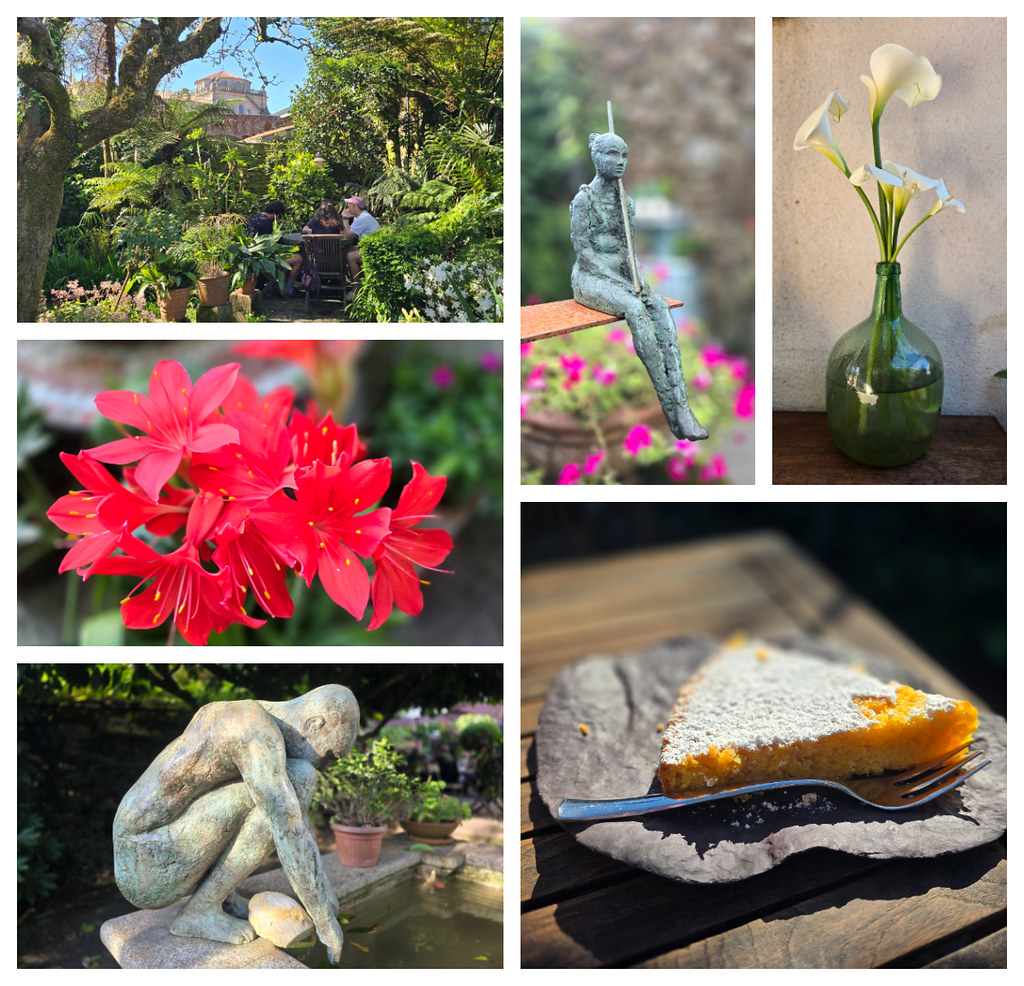
The garden at Cafe Costa Vella, Santiago de Compostela.
I can’t comment on the quality of the food here, but their coffee and Torta de Santiago is the best!
I’ve heard a rumour that this place has temporarily closed. I hope it’s not true, and, if it is, I hope that it’s only for the winter months and that they’ll open up again in the spring.
3 | Choiva Cafe | Rúa de Aller Ulloa, 3
Located right opposite the Museo do Poblo Gallego, Choiva Cafe has both indoor and outdoor seating available.
Whilst not as good value for money as Café Tertulia, their food is fresh and tasty. There’s a good selection of tostadas, filled croissants, and breakfast bowls, along with cakes and pastries.
4 | Cáscara Cáfe & Brunch | Rúa da Troia, 6
This place doesn’t solely serve breakfast and brunch (they’re actually open until 8 p.m most days (9 p.m on a Saturday and Sunday)), but I’m listing it under this heading as they seem to have a wider choice of breakfast and brunch items compared to their ‘Main Dish’ offerings.
Cáscara serves tostadas, a variety of egg-based dishes, breakfast bowls and a small selection of sandwiches and wraps.

Food and coffee at Cáscara Cáfe & Brunch, Santiago de Compostela
They’re serious about their coffee here too, so definitely add this place to your list if you’re someone who appreciates good coffee.
Good to know: They’re closed on Wednesdays.
5 | Mori Café | Rúa Nova, 32
Primarily a coffee shop serving coffee roasted in Santiago de Compostela itself, they also serve a small selection of tostadas (including my favourite: smoked salmon and avocado), sweet waffles and cakes.

My favourite breakfast…just needs a poached egg on top! (Mori Café, Santiago de Compostela)
It’s located along one of Santiago’s busiest streets in the historic centre (opposite the church of Santa María Salomé), so it’s a great place for people watching, too.
6 | Bruma Coffee Shop (was Ratiños) | Praza de Entrepraciñas, 4
I found this place online when I was searching for somewhere to get a decent cup of coffee after almost two weeks of settling for (mostly) very mediocre café con leches along the Camino Primitivo.
Alongside Mori Cafe and Shot Me Coffee (located to the northeast of Santiago’s historic centre, the other side of Parque de San Domingos de Bonaval), Bruma Coffee Shop completes the speciality coffee line up in Santiago de Compostela.
Operating as a roastery and minimalist cafe, Bruma serves up 100% arabica single origin coffee brewed in small batches. Although they do have a small selection of sweet and savoury snacks available, you come here primarily for their top quality coffee.
Tapas and Snacks
1 | Bar La Tita | Rúa Nova, 46
Bar La Tita has a bit of a reputation for their legendary tortilla. They serve a local variation on the Spanish classic which is made without onion (just potatoes, egg, salt, and olive oil), and it will always be barely set, still gooey inside. Which is exactly how I like it.
At Bar La Tita, you order a beer (any size) and you’ll receive a fairly generous slice of really good tortilla completely free of charge.
If you’re on a budget, you can certainly fill up on tortilla here for the price of a couple of small beers.
Of course, if tortilla isn’t your thing, there is a full tapas and raciones menu available.
2 | Tapas Petiscos Do Cardeal | Rúa do Franco, 10
Considering that this place is located along one of the busiest, most touristy streets in Santiago de Compostela, the prices are actually really reasonable and the service is quick.
There’s a sit-down restaurant area in the back or, if you’d rather just grab a drink or choose from their appetising range of pinchos, there are stools available in the bar area.
3 | Bico de Xeado | Rúa do Vilar, 81
Many argue that this place serves up the best ice cream in Santiago de Compostela. The long queues here would certainly seem to back this up.
Santiago de Compostela’s offering is actually part of a small Spanish chain — a fact I only recently discovered when I spotted a Bico de Xeado in Santander close to the city’s cathedral.
When I last visited, there were 26 different flavour combinations to choose from. The descriptions are only in Spanish, but there are helpful little pictures beside each one.

Ice cream at Bico de Xeado, Santiago de Compostela.
I’ve sampled pistachio, hazelnut and turrón de jÿona (soft almond nougat) and loved them all. It’s become a bit of a tradition of mine (if I luck out with sunshine and blue skies when I’m in the city) to get an ice cream from Bico de Xeado and then take a relaxing wander around nearby Alameda Park.
Healthy Eats
1 | A Carrilana | Rua de San Paio de Antealtares 16
I decided to check out this place based on its great reviews and vast array of healthy meat-free food options. After walking the Camino Primitivo and living largely on bread and cheese for the duration, I was craving some raw vegetables and salad. One look at the photographs of the colourful poke bowls on their website and I was sold!
Although there was a bit of a wait for a table when I arrived, I whiled away my time over a beer at the bar, and was well and truly ready for my food by the time I was able to order it. Fortunately, it was worth the wait — I loved my ‘Vegetable Love’ salad and beetroot, apple, mint, ginger and lemon juice drink.
Things to do in Santiago de Compostela | Getting to the City
Santiago de Compostela has its own airport, located just 13 kilometres northeast of the centre of the city. In fact, you walk past it on the final day of the Camino Primitivo.
You can catch bus number 6A to get to the centre of the city from the airport. Departures are every 30 minutes and the the journey takes around 30 minutes. You’ll find the closest bus stop to the historic centre here (around a 10-minute walk from the cathedral). A one-way fare is just €1 (correct, November 2026).
If you’re UK-based, you’ll only be able to fly directly to Santiago de Compostela from London. Vueling use Gatwick airport and Ryanair fly from Stansted. It’s also possible to fly indirectly from local airports, usually involving a change in Barcelona or Madrid.
Alternatively, Santiago de Compostela’s bus and train station (they share the same building — linked via a pedestrian footbridge) is located just 1.7 kilometres / 1.1 mile south of the city’s cathedral (around a 20-minute walk). So, if you’re travelling to Santiago de Compostela from elsewhere in Spain, this is more than likely where you’ll end up.
Another option (and one I used when I walked the Camino Finisterre) is to fly into Porto in Portugal. Although it’s in a different country, Porto is significantly closer to Santiago de Compostela than Madrid, for example. I caught a Flixbus from Porto airport to Vigo (Spain) and then hopped on a train to Santiago de Compostela. Conveniently, Vigo’s bus and train stations are integrated at the Vialia/Urzaiz Intermodal Terminal, so it’s easy to change between the two. You can travel from Porto airport to Santiago de Compostela in approximately four hours (depending on the connection time in Vigo).
If you enjoyed this post about my guide to the best things to do in Santiago de Compostela, why not pin it to one of your Pinterest boards for reference?


Alternatively, you can follow me on Instagram below 


No Comments