

In this post, I share helpful information, tips and advice for walking the Camino Finisterre, along with a 5-day itinerary which includes Muxia.
Some of the links in this post are affiliate links. All this means is that if you make a purchase through one of the links I have provided, I will earn a small commission as a result but the cost to you will remain exactly the same.
There aren’t many hiking trails that can be completed in their entirety in under a week, but the Camino Finisterre is one of them. It takes you from the historically and religiously significant city of Santiago de Compostela (the capital of Galicia) to Cape Finisterre on the Costa da Morte (Coast of Death).
You’ll walk through shaded woodlands and swathes of pine and eucalyptus forests, past ancient churches, monasteries, and pretty medieval towns, and along peaceful riverside trails, to finally finish up at the coast, dipping your toes into the waters of the Atlantic ocean.

The waves of the wild Atlantic Ocean, Lires, Cee, Galicia
Other hiking trails to consider if you’re short on time are the Liechtenstein Trail (4 days), the original Fishermen’s Trail (4 days), Hadrian’s Wall Path (6 days), and the Sandstone Trail (2 days).
When I walked the Camino Primitivo in August 2024, I desperately wanted to continue on to Finisterre and finish my journey at the coast, but I simply didn’t have time, even if I sacrificed the two days I spent exploring Santiago de Compostela at the end of my walk.
So, I made it my mission to return the following August and walk the Camino Finisterre in its entirety.
I say in its entirety because a lot of hikers simply walk to Finisterre and then catch the bus back to Santiago, but the full trail goes to both Muxia and Finisterre (the path splits at Hospital). So, my plan was to follow the signs for Muxia at the split, then walk from Muxia to Finisterre and then from Finisterre to Hospital, where I would catch the bus back to Santiago to avoid walking the same ground in reverse.
To demonstrate this in pictorial form, here is a helpful map of the entire Camino Finisterre route:

Camino Finisterre route map, shared via Gronze – an incredibly helpful website which I use religiously when planning my Camino walks.
About the Camino Finisterre
Cape Finisterre was historically considered the westernmost point of the known world — hence its name, ‘Finisterre’, which literally translates to ‘the end of the world.’
The Camino Finisterre is the only one of the Camino de Santiago routes to actually start in Santiago de Compostela, which is why a lot of walkers tag it on to the end of one of their longer routes.

Scenes from Santiago de Compostela, the start point of the Camino Finisterre
The length of the Camino Finisterre (and the time it takes you to walk it) is dependent upon which route you choose to take. If you walk to Finisterre only (which is as far as you need to walk to claim your Finisterrana Certificate — more on this later), you can reach this coastal town in just three days.

Scenes from Finisterre – the end point of the Camino Finisterre
Your options for walking the Camino Finisterre from Santiago de Compostela are as follows:
- Walk to Finisterre, finishing at the lighthouse — the official end point of the route | 89.4 kilometres (55.6 miles).
- Walk to Muxia and then continue on to Finisterre, finishing at the lighthouse | 116.1 kilometres (72.1 miles).
- Walk the entire route (as I did) | 143.1 kilometres (88.9 miles).
Of course, you do also have the option to walk to Muxia only (85.3 Kilometres / 53 miles). Or, to walk to Finisterre first and then continue on to Muxia.
In many ways, I preferred Muxia to Finisterre (for reasons I’ll cover later on in this post), so it does make a very worthy end point. And, of course, it’s also on the coast, so you’ll still finish your walk by the sea.

Sea views on the approach to Muxia
How busy is the Camino Finisterre route?
Despite being an easy add-on to the main Camino de Santiago routes, only a small percentage of pilgrims continue on to walk the Camino Finisterre extension.
To back that up with some statistics, according to the Oficina del Peregrino, 530,000 pilgrims walked one of the Camino routes to Santiago de Compostela in 2025, but only 2381 walked the Camino Finisterre — that’s under 1%.
I certainly found the route incredibly quiet and I walked it in August, which is statistically one of the busiest months on the Camino Finisterre.

Following the shells on the Camino Finisterre
What time of year should I walk the Camino Finisterre?
This is Galicia — expect rain at any time of year! However, the driest months are July and August, with an average monthly rainfall of 19 mm, compared to 149 mm in December and January.
Temperature-wise, the average high for Galicia during July and August is 25 degrees, with an average low of 14 degrees.

I saw lots of grapes growing on the vines along the Camino Finisterre
When I walked the Camino Finisterre towards the end of August last year, I saw temperatures topping out at 34 degrees on my first day on the trail! Fortunately, the temperatures returned to the low twenties for the remaining four days. I only saw a tiny bit of rain at the start of day four until my final day on the trail, when it started raining around midday and didn’t stop for the rest of the day!
It was the second time I’d arrived into Santiago de Compostela in the pouring rain, albeit by bus this time around.
So, in summary, you need to be prepared for rain regardless of the season, but temperatures will be noticeably warmer between the months of June and September.

A selection of the fruits, beans and nuts I saw growing in trees along the Camino Finisterre during the summer months
Personally, I hate walking in the rain. I take a lot of photos and video, and trying to do this in the rain, whilst also trying to hold an umbrella (to protect my electronics), is challenging! Not to mention using a navigation app in the rain (or attempting to!). It’s also impossible to get all your kit dry in the evening, in preparation for the following day on the trail.
For those reasons, I chose to walk the Camino Finisterre during one of the driest months of the year. I knew it wasn’t a popular route, so I wasn’t concerned about the number of other pilgrims I’d encounter along the way. And, I’m generally okay walking in temperatures up to 30 degrees, so an average high of 25 degrees was not an issue for me at all.
How difficult is the Camino Finisterre route?
Although, I didn’t find the terrain or elevation as challenging as the Camino Primitivo had been, I walked some big miles on the Camino Finisterre. My average daily distance was 30.77 kilometres, compared to 24.9 kilometres on the Camino Primitivo. I chose to walk longer days partly because I knew that the route was short (five days), partly because I knew the walking was going to be easier, and partly because it made logistical sense to do so.
However, for those of you who are walking the Camino Finisterre at the end of a long Camino route (if you’ve just walked the Frances, you’ll have already been on your feet for around 30 days before even starting the Finisterre), it will feel probably feel significantly more difficult, because your body will already be tired.

Pinks and greens along the Camino Finisterre
As a stand alone Camino though, I’d grade the Camino Finisterre as easy to moderate. There are some long days on your feet, but there aren’t many difficult climbs. Two of the three main ascents that I remember are not even on the main trail. They are:
- One of the alternative routes between Muxia and Finisterre that heads out to Praia de Lires and then ascends through forest trails to join the main path just outside A Canosa.
- The alternative route to the lighthouse in Finisterre, which takes you, via A Insua, up on to the headland to the Sacred Stones (‘Piedras Santas’), high above Cape Finisterre.
The third was on my fifth day of walking, after leaving the town of Cee, when I was on my way back to the Hospital split. If you finish your walk in Muxia or Finisterre, you only walk to Finisterre, or you walk to Finisterre first of all, and then continue on to Muxia, then you won’t have this ascent to contend with.
There are also facilities (shops/cafes/bars/restaurants) at regular enough intervals along the trail, thus avoiding the need to carry a lot of food and water. The only day I did have to walk quite a long way (5.8 miles) to find breakfast was day two, but that was primarily because it was a Sunday and none of the cafes in Negreira (my starting point) seemed to open before 9 a.m. Whilst I could have waited for 9 a.m. to roll around, I knew I had a 35 kilometre day ahead of me, so I wanted to be on the road by 8:30 a. m.

The front and reverse of an amusing sculpture in Negreira
There is a supermarket (Google Maps location here)in Negeira, so you can buy your own breakfast supplies. The only reason I didn’t was because my host at the apartment I was staying in assured me that one particular cafe in town would be open at 8 a.m. and, sadly, it wasn’t. My recommendation would be to pick something up from that supermarket the evening before (it’s open until 9:45 p.m. every day other than Sunday) — if you don’t need it for breakfast, at least you’ll have something to snack on along the way.
If I only have time for Finisterre OR Muxia, which one should I choose?
As I mentioned previously, as a destination in itself, I preferred Muxia, for the following reasons:
- It’s noticeably quieter, even in peak season. More people go to Finisterre than Muxia. It’s a popular day trip from Santiago de Compostela, both for pilgrims who’ve finished a Camino but don’t have time to walk there, and for tourists who are staying in the city but fancy a trip to the coast for the day.
- The Cape in Muxia is significantly closer to the town. Although I loved the walk to Finisterre’s lighthouse (particularly the alternative route), it’s too far away to visit more than once while you’re in town. Whereas, I could walk to the lighthouse in Muxia when I initially arrived and return for sunset, because it’s only a 10-minute walk from town.
- There are more places of interest in Muxia. Namely, the Sanctuary da Nossa Señora da Barca, A Ferida monument, Piedra de Abalar, Piedra dos Cadrís, and Monte Corpiño viewpoint.
However, Finisterre is, historically, the end of the Camino route. And can you really say you’ve walked the Camino Finisterre if you don’t actually make it to Finisterre?

The official end of the Camino Finisterre is at the lighthouse in Finisterre
It’s a tricky one — in an ideal world, I’d recommend that you visit both. The 27.6-kilometre route between the two is also beautiful, so it would be such a shame to miss out on walking that.

The beautiful approach into Finisterre on the Muxia to Finisterre section
However, if you only have time for one, I’d recommend choosing Finisterre if it’s important to you to walk the official route to the end of the world (Muxia was originally considered to be simply an extension of this official route) or if you’d prefer to finish in a lively, tourist-friendly town, with better transport links back to Santiago de Compostela.
On the other hand, if you prioritise beauty and solitude, and you’re seeking a calmer, more reflective end to your journey, then I’d recommend choosing Muxia.

Muxia is a much quieter finish point than Finisterre, and there’s lots more to see there, too.
Walking the Camino Finisterre | Planning your Stages
As the Camino Finisterre is such a short Camino, there aren’t as many options available to split the stages as there would be on a longer Camino.
The primary resource I used for planning my stages was Gronze. A fellow pilgrim introduced me to Gronze while I was walking the Camino Primitivo, and it’s been my go-to Camino planning site ever since.
Gronze breaks the Camino Finisterre up into three stages if you’re walking to Muxia, and four stages if you’re walking to Finisterre, with an additional (very short) stage from Finisterre to the lighthouse. There’s also the stage (4M on the picture below) between Muxia and Finisterre, if you’re walking to both places.

Camino Finisterre stages, taken from the Gronze website
I was able to adapt this into five stages by combining stage 4M with stage 5, and stage 4F with the part of stage 3F that runs between Corcubión and Hospital, making that stage 26.97 kilometres (16.8 miles). So, I planned my stages as follows:
- Day 1 | Santiago de Compostela to Negreira | 20.6 kilometres
- Day 2 | Negreira to Olveiroa | 33.6 kilometres
- Day 3 | Olveiroa to Muxia | 31.1 kilometres
- Day 4 Muxia to Finisterre | 27.6 kilometres (plus I took the alternative route to the lighthouse and the standard route back, so I walked an additional 7.6 km)
- Day 5 | Finisterre to Hospital | 27 kilometres
If you’d also like to walk the Camino Finisterre in its entirety, you’ll need to time your arrival into Hospital with the bus to Santiago, as the departures are not particularly regular. I’ll go over this in more detail further along in this post.

Scenes along the Camino Finisterre
If you want to avoid walking 30+ kilometre days, it is possible to walk Santiago — Muxia — Finisterre in the following five stages:
- Day 1 | Santiago de Compostela to Negreira | 20.6 kilometres
- Day 2 | Negreira to Santa Marina | 20.7 kilometres
- Day 3 | Santa Marina to Dumbria | 23.1 kilometres
- Day 4 | Dumbria to Muxia | 20.9 kilometres
- Day 5 | Muxia to Finisterre | 27.6 kilometres (but you will need to add 6.4 kilometres for the walk to the lighthouse and back, which does make the total over 30 km)
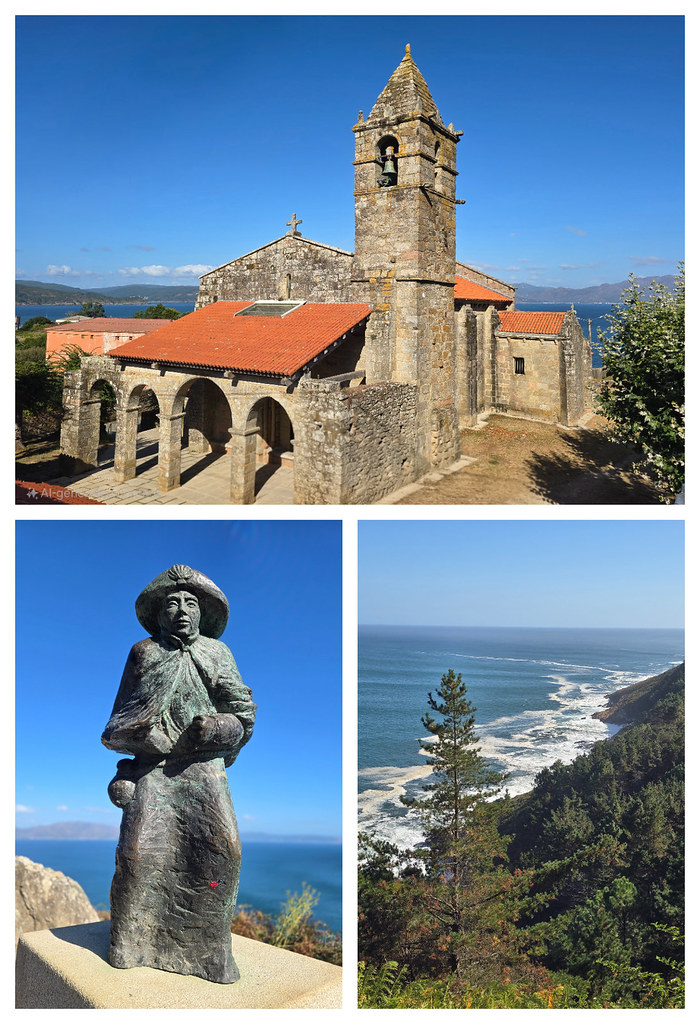
On the walk to/from Finisterre’s lighthouse, you’ll pass these sights
Or Santiago — Finisterre — Muxia in the following six stages:
- Day 1 | Santiago de Compostela to Negreira | 20.6 kilometres
- Day 2 | Negreira to Santa Maria | 20.7 kilometres
- Day 3 | Santa Marina to Hospital | 17.9 kilometres
- Day 4 | Hospital to Corcubión | 16.4 kilometres
- Day 5 | Corcubión to Finisterre | 10.6 kilometres (plus an additional 6.4 kilometres to the lighthouse and back)
- Day 6 | Finisterre to Muxia | 27.6 kilometres
You’ll need an additional day if walking to Finisterre first of all, simply because of where accommodation is available along the trail. And, if you’re walking back to the split at Hospital (as I did), you can add an extra 27-kilometre day if walking from Finisterre, or an extra 26.1-kilometre day if walking from Muxia.
Walking the Camino Finisterre | Resources
The following are resources I use to plan every Camino I walk. I’m walking the Camino Portugués (and doing a combination of the coastal and central routes, including the Spiritual Variant), starting next week, which will be my third Camino.
- Gronze. As I mentioned above, Gronze is my go-to Camino-planning site. It’s the first place I head when I’m thinking about walking a new Camino.
- Buen Camino app. I use this in conjunction with Gronze, as well as when I’m actually on the Camino. Their maps show all the alternative variants in blue, and you can see where you are on the map in real time. Buen Camino is also great for locating services along the route.
- Footpath app. This is an app I’ve been recommending for years. Although most of the Caminos are well way-marked, I always map my route on Footpath the evening before I walk, so that I’ve got it as a back-up. Once the route is mapped, you can follow it without internet or phone signal. It shows where you are on the map and the elevation along the route, and, if you happen to go off trail, you can easily find a way to re-join it.
- Camino Finisterre guidebook. Whilst apps are great, I still like to travel with a paper guidebook too. And this one is really small and lightweight (I guess because the Camino Finisterre is a short route). However, you can buy guides to the longer Caminos that include the Finisterre extension, such as the Camino Frances, Camino Inglés, and the Camino del Norte and Camino Primitivo.
Walking the Camino Finisterre | Accommodation
When I walked the Camino Primitivo, I stayed in a combination of private rooms and shared dorms, partly to keep the costs down and partly so that I wouldn’t miss out on the social aspect of the whole experience. However, as the Camino Finisterre was only going to be a five-day walk for me, I wasn’t so bothered about forming friendships along the way. And, I was pretty sure that five days wasn’t long enough to do so anyway.
Walking for only five days also meant that I could afford to spend a little more per night on my accommodation, because I was only away for seven nights (I had a night in Santiago de Compostela at either end of my walk) instead of 17 nights when I walked the Camino Primitivo.
I booked all my accommodation in advance, because I had a very limited amount of time with which to walk the Camino Finisterre, I’d planned my stages in advance, and I knew exactly where I’d be spending each night. Whilst I probably would’ve been okay not booking in advance in most places I stopped at, Olveiroa is only a small village (albeit a very pretty one) with a very limited choice of accommodation available. I also wanted to ensure that I could stay on trail (or as close as practicable) in as many places as possible, due to already walking some long days, without adding detours to accommodation on top of that.

Incredible street art spotted on my arrival into Olveiroa
Like other Camino routes, you’ll generally have the choice of staying in the following types of accommodation:
- Municipal albergues. Theses are like hostels, run by the local municipality, and are for pilgrims only (you have to show your credential when you check in). You cannot book municipal albergues in advance — beds are available on a first-come, first-served basis. Municipal albergues are your cheapest option on any Camino.
- Private albergues. These are privately-run hostels where anyone can stay, and you can quite often book these in advance. They will usually have dorm rooms available as well as a small number of private rooms too.
- Pensions. These are small, often family-run guesthouses with a few private rooms available. Sometimes, you’ll have to share bathrooms; sometimes you won’t.
- Hotels. You’ll generally only find these in the larger towns and cities. Fairly self-explanatory – private rooms with private bathrooms.
However, if you’d prefer to stay in private rooms, here is a list of all the places I stayed, 100% of which I would recommend, but some I loved more than others.
- Day 0 | Deniké, Santiago de Compostela. This was my second stay here; it’s in a really nice part of the city and is just 400 metres from the cathedral.
- Day 1 | Mouritz Rooms, Negreira. Right in the centre of town, literally steps (less than 10!) from the trail. The host here was super helpful and provided me with lots of recommendations for places to eat in town, and for the trail itself. My room was huge (much bigger than I needed), modern and super clean.
- Day 2 | Bar and Pensión Rústica As Pias, Olveira. This was my favourite of all the places I stayed along the trail (and it is right on the trail, too). Traditional and rustic with oodles of character. Also has its own bar and restaurant, so you don’t have to go far for food.

Bar and Pensión Rústica As Pias, Olveira, Camino Finisterre
- Day 3 | Bella Muxía, Muxia. This place was way more luxurious than I expected, given the price I paid. I bagged one of their private rooms on the top floor with a terrace and sea views, but they also have dorm rooms available in the attached albergue.

Bella Muxia, Muxia, Camino Finisterre
- Day 4 | Hospedium H Cabo Sport, Finisterre. Located above a sports shop (you have to walk through the sports shop to reach the check-in desk), just steps from the harbour, numerous cafes, bars and restaurants, and the bus stop for buses back to Santiago. My room was lovely, too.
- Day 5 | Os Sobriños Do Pai, Santiago de Compostela. Located above a restaurant of the same name, this is even closer to the cathedral than Deniké. Although the single rooms are pretty small (I lucked out with a double room in the loft the first time I stayed here), it’s clean, comfortable and great value for money, given the location.
Walking the Camino Finisterre | Getting to or from Santiago de Compostela
Many of you reading this will probably be walking the Camino Finisterre as an extension of another Camino route, in which case, you’ll already be in Santiago de Compostela. But, for those of you walking it as a stand alone route (as I did), you’ll need to get yourself to Santiago de Compostela.
Santiago does have its own airport, but, if you’re UK-based, you’ll need to get to London in order to fly there, which isn’t necessarily doable for a lot of people. For me, the departure time of the flight from London was too early in the day (I’d have had to stay in London the night before), so I chose to fly to Porto from my local airport in Birmingham, and then to get a Flixbus to Vigo, followed by a train to Santiago de Compostela. Conveniently, Vigo’s train station is across the road from its bus station, so the journey worked really well, and I still had the whole afternoon to spend in Santiago.

Parque de San Domingos de Bonaval, Santiago de Compostela

Covento de Belvis, Santiago de Compostela
I did fly home from Santiago, though, as the early afternoon departure meant that I had plenty of time to get back from London to Shrewsbury.
When you finish the Camino Finisterre, you have several options to get back to Santiago de Compostela, depending on where you finish.
- From Finisterre | There are several buses per day, with a journey time of 2-3 hours. Timetables can be found here. Just remember to type the Galician spelling of Finisterre (‘Fisterra’) in the ‘departure point’ box. You can see location of the bus stop in Finisterre on Google Maps by following this link.
- From Muxia | The buses aren’t quite as frequent from Muxia, but the journey time is under two hours. Timetables can be found here. The bus leaves from Cafeteria Don Quijote and also stops at the bar O’Xardin.
- From Hospital | Pay no attention to Google at all when searching for the bus stop; just head straight to Bar Casteliño (it’s on the trail just before you arrive into the main part of town) and stick your hand out when the bus approaches. There is a large car park in front of the cafe, so the bus has plenty of room to pull in. Timetables can be found on the Transporte Público de Galicia website here. However, it’s important to note that on the day that I wanted to travel (a Wednesday at the end of August), there were only two departures — one at 15:32 and one at 17:17. And, my 15:32 bus didn’t arrive until around 15:45.
Once you’re back in Santiago, the easiest way to get to the airport is to catch the 6A airport bus from here. It’s a 10-minute walk from the cathedral. There are departures every 30 minutes and the fare is just €1 (correct, August 2025). Alternatively, if you’re heading elsewhere in Spain, you’ll find Santiago de Compostela’s train station here or the bus station here.
Picking up your credential
Whilst you will not be able to get a Compostela for walking the Camino Finisterre, you can still obtain a certificate of completion. Or two certificates, if you’ve walked to both Finisterre and Muxia.
You’ll need to pick up a specific Finisterre/Muxía pilgrim credential at the Oficina de Peregrino in Santiago de Compostela, prior to starting your walk. The requirement is then to collect at least one stamp per day (stamps are available at albergues, churches, town halls, and some bars or restaurants) as evidence that you’ve walked the route.
The Finisterrana certificate (if you’ve walked to Finisterre) is available from the Tourist Information Office or the Municipal Albergue in Finisterre. The Muxiana certificate (if you’ve walked to Muxia) is only available from the Tourist Information Office in Muxia, as far as I’m aware — correct me if I’m wrong!
Walking the Camino Finisterre | Camino Finisterre route stages
Day 1 | Santiago de Compostela to Negeira (20.6 kilometres / 12.8 miles)
⇒ Actual distance walked: 21.59 km (13.4 miles) | Time taken to complete: 4 hours 32 minutes | Elevation gain: 501 metres
It was a lovely, peaceful, easy walking today, lots through shaded woodlands (much like the Primitivo), passing through several pretty little villages along the way.
Highlights
Breakfast at one of my favourite cafes in Santiago de Compostela. When I found out that the Camino Finisterre route goes right past Café Tertulia, obviously I had to factor in a stop there for breakfast. I knew I had a short day ahead of me, so I arrived shortly after they opened their doors at 8 a.m. (for info, they open at 7:15 a.m. during the week), and ordered a tostada with my favourite topping — cream cheese, smoked salmon and rocket — while researching a little of what lay ahead for me on the trail today.

Breakfast at Café Tertulia, Santiago de Compostela
Crossing the pretty Río Sarela. It was at this point that I really felt as though I’d left the outskirts of the city and had arrived in rural Galicia. It was so tranquil and picturesque down here that I remember feeling so excited about the walk ahead.

Crossing the pretty Río Sarela, day 1 on the Camino Finisterre
The Baroque church of Trasmonte. This is a small diversion from the main trail, but is well worth it — I had the entire grounds to myself while I wandered around and snapped photos.

The Baroque church of Trasmonte, Camino Finisterre
My arrival into the ridiculously picturesque village of Ponte Maceira, with its scenic riverside location, medieval bridge, and 18th century chapel and mill. This was one of my favourite places along the whole Camino Finisterre route — factor in at least an hour here to simply wander around, soaking up the views; sitting on the rocks, reading a book; or going for a swim.

Ponte Maceira was one of my favourite places along the whole of the Camino Finisterre route

The pretty riverside town of Ponte Maceira, Galicia

If you’ve packed your costume, swimming in the shallow waters is a popular activity here in Ponte Maceira

The old mill at Ponte Maceira
Pazo de Cotón, a medieval fort in Negreira. You’ll actually pass this as you leave town the next day, but I’m mentioning it here because you won’t catch the sun on it first thing in the morning.

Pazo de Cotón, a medieval fort in Negreira
Food and Drink
A Casa do Boi, Ventosa. This is an albergue with an attached cafe set in a pretty little garden, and is where I made my first coffee stop after leaving Santiago. It’s just 20 metres off the main trail. 100% recommend. I even got a free cake with my coffee. You’ll find it 9.8 kilometres in, so pretty much at the half-way point.

Coffee break at A Casa do Boi
There are also cafes/bars in Quintáns (7km), Alto do Vento (8.7km), Augapesada (11.5km), Trasmonte (14.9km), Ponte Maceira (16.8km), and A Chancela (shortly before your arrival into Negreira). Opening times may vary, depending on the time of year and day of the week.
Day 2 | Negeira to Olveiroa (33.6 kilometres / 20.9 miles)
⇒ Actual distance walked: 35.17 km (21.9 miles) | Time taken to complete: 6 hours 58 minutes | Elevation gain: 728 metres
After yesterday’s beautiful section, today was a bit samey – forests and fields! And the only settlements I passed through were agricultural hamlets, so mainly farm buildings and cows and not much else!
Highlights
Pazo de Cotón. Although I mentioned this on the previous day’s highlights, it’s still nice to make a brief stop here again the next morning, in order to capture it in a more subdued light.

Pazo de Cotón at sunrise, Negreira
The alternative route out of Negreira, which follows the Río Barcala (‘variante del paseo fluvial‘). This adds almost a kilometre on to today’s walk, but it makes a lovely start to the day, witnessing the soft light of the early morning sun filtering through the trees. You’ll need to keep your eyes peeled for the turn off — I missed it and had to turn back.

The alternative route out of Negreira takes you through woodland and alongside the Río Barcala
Mirador de Monte Aro. After hours of agricultural scenery, it was lovely to be treated to views over the Xallas Valley and the large Fervenza Reservoir.

Agricultural scenery and the first views of the Fervenza Reservoir, Camino Finisterre
My overnight stop in the pretty village of Olveiroa. Whilst you won’t find much in the way of services here (there’s no ATM and the only ‘shop’ has a very limited selection of goods), the whole place is so tranquil and picturesque. And my accommodation for the night (Pension As Pías) felt like an embodiment of Olveiroa’s rustic charm and authenticity.

The pretty little village of Olveiroa, Camino Finisterre

Wind turbines on the horizon at sunset, viewed from my room at Pension As Pias
Food and Drink
Zas Takeaway. Despite the name, this little coffee stand (they also sell juices and snacks) does have a very small seating area, too. Seeing as though I’d not been able to find anywhere open in Negreira when I left (it was a Sunday), I had a bit of a “hallelujah!” moment when I spotted this place 4.2 kilometres in (although, if you take the standard route, not the riverside alternative, it will be 3.3 kilometres in).
Albergue Cafetería Alto da Pena. This was the first place I arrived at today that served anything resembling breakfast. They’ve got a lovely garden with outdoor seating, along with quite a few seats inside, too. Service wasn’t especially speedy when I visited, but the staff were lovely and the portion size of my tostada con tomate y queso (tomatoes and cheese on toasted bread) more than made up for the wait time, considering how hungry I was by this stage! You’ll find this cafe nine kilometres in (9.9 if you’ve followed the earlier alternative route, as I did).
There are also cafes/bars in Vilaserío (12.8km), As Maroñas (19.7km), Santa Mariña (20.7km), Lago (27.3km), San Cristovo de Corzón (29.3km), and Mallón (0.44km before Olveiroa). Opening times may vary, depending on the time of year and day of the week.
Day 3 | Olveiroa to Muxia (31.1 kilometres / 19.3 miles)
⇒ Actual distance walked: 32.99 km (20.5 miles) | Time taken to complete: 6 hours 48 minutes | Elevation gain: 653 metres
Gronze rated the landscape better yesterday than today, but I disagree! I loved today’s walk through swathes of pine and eucalyptus forests, past numerous churches and a monastery, and finishing up by the sea.
Highlights
The pretty little village of A Grixa. Blink and you’ll miss this place, but it does have an albergue and a couple of pensións. There’s also a lovely little church (San Cibrán de Vilatose) whose bell tower has been removed and currently lives on the other side of the street!

San Cibrán de Vilatos Church in A Grixa, Camino Finisterre
Witnessing the sausage dog of grain stores in San Martiño de Orzón. It’s the longest in Spain, at 27 metres in length!

The sausage dog of grain stores, San Martiño de Orzón
Heading down to the first beach I came to when I arrived at the coast, and finding it completely empty! This happened to be O Muiño Vello in Enseada de Merexo bay.

O Muiño Vello beach in Enseada de Merexo bay, Muxia
Church of San Xulián de Moraime. Shortly after reaching the coast, the trail headed inland again and threw in a few hills for good measure. Finding this beautiful church (formerly a 12th century Benedictine monastery) gave me an excuse to stop for a few minutes, take my pack off my back, and snap a few photographs.

Church of San Xulián de Moraime, Muxia
Arriving into Muxía and heading down to see the lighthouse and church (Santuario de Virxe da Barca) — twice! Although I could’ve dropped by backpack at my accommodation before walking here, I wanted my journey to Muxia to finish at its lighthouse (which is why my ‘actual distance walked’ is a bit further than Gronze stated). I also wanted time to sit on the rocks soaking up the sunshine at the end of my walk. And then, of course, I had to return for sunset.

The Cape in Muxia at sunset
Food and Drink
Cafes are few and far between on today’s stretch — unless you’re willing to leave the trail.
Casa da Coxa, Senande. This was the first (and only) cafe I stopped at and it was 15.9 kilometres (10 miles) in! It’s a proper little sun trap here, so if you’ve lucked out with the weather on the day that you’re walking this section, you won’t want to leave!
There are also cafes/bars in O Logoso (3.6km), Hospital (5km), Dumbria (10.2km), A Grixa (16.8km), Quintáns (21km), San Martiño de Orzón (23.2km, off trail), Os Muiños (26.5km, off trail). Opening times may vary, depending on the time of year and day of the week.
Day 4 | Muxia to Finisterre (27.6 kilometres / 17.1 miles)
⇒ Actual distance walked: 37.1 km (23.1 miles) | Time taken to complete: 7 hours 48 minutes | Elevation gain: 937 metres
Once the weather cleared (it was raining when I first left Muxia), it was another lovely day on the Camino Finisterre, with the second half of the trail never straying far from the coast. My actual distance walked includes alternative routes to both Praia de Lires and Finisterre’s lighthouse, as well as the walk back to town from the lighthouse, along the standard route. It was a long day and the soles of my feet were definitely not happy by the end of it!
Highlights
Following the alternative route out to Praia de Lires. I absolutely loved this particular alternative route, partly for the stunning coastal scenery and partly because I didn’t see a single other person walking it. The turn off is just past hotel and restaurant, LiresCa in Santo Estevo de Lires.

I loved the alternative route out to Praia de Lires between Muxia and Finisterre
Taking the alternative route from Finisterre to the lighthouse via A Insua. This involves quite a climb up on to the headland, but the views are stunning and I only met one other person doing the same.

Taking the alternative route from Finisterre to the lighthouse via A Insua
My delicious celebratory meal at Restaurante o Centolo in Finisterre. One of the best ensaladas mixtas (mixed salads) I’ve ever eaten followed by pulpo a la plancha con cremoso de patata (grilled octopus with creamed potatoes). As far as meals on the Camino Finisterre go, this was easily the best!

My delicious celebratory meal at Restaurante o Centolo in Finisterre
Food and Drink
LiresCa, Lires. Strictly a hotel (and a very nice looking one at that), but I saw a few pilgrims sat on the outside tables, so I wandered on in, unsure about what there would be in the way of services once I took the coastal variant. They serve food here too, but I just stopped for coffee.
Bar Playa de Lires. When I saw this place (or rather, the view from its outdoor terrace), I wished I’d not stopped for coffee back in Lires. It was a bit too soon to stop again, and I was conscious of the number of miles I still had left to walk. If I walked this section of the Camino Finisterre again, I’d definitely choose to stop here for a drink.
There are also cafes/bars in Morquintián (8km), Lires (14.3km), Buxán (20.8km), and San Salvador (23.5km). Opening times may vary, depending on the time of year and day of the week.
Day 5 | Finisterre to Hospital (27 kilometres / 16.8 miles)
⇒ Actual distance walked: 27 km (16.8 miles) | Time taken to complete: 5 hours 26 minutes | Elevation gain: 713 metres
Unfortunately, the weather was cloudy and wet all day today (although, the heavens didn’t properly open until I’d almost made it to Hospital), so it didn’t make for a particularly inspiring walk — I definitely preferred the section between Muxia and Hospital.
Highlights
The colourful town of Corcubión, with its cobblestone streets, attractive beach, and Church of San Marcos. When I passed through Corcubión, I was actually wishing I had time to stop for a while and have a look around, but I was very conscious of ensuring I was back at Hospital in time for my bus. As it happened, I arrived into Hospital over an hour before my bus departed but, at the time, I wasn’t prepared to take that risk.

Arrival into colourful Corcubión on a cloudy day along the Camino Finisterre
The Sanctuary of A Nosa Señora das Neves. Although this place wasn’t as inspiring as some of the other churches I passed on the Camino, it was a lovely distraction amidst miles of woodland.

The Sanctuary of A Nosa Señora das Neves
The weird and wonderful Vakner sculpture. Whilst religious sculptures are commonplace on the Camino, I did not expect to come face-to-face with this five-metre tall creature! Having since researched its significance, I can now inform you that he is a mythological figure who once terrorised pilgrims. The bronze ‘werewolf’ sculpture was created by sculptor Cándido Pazos, and is the first sculpture dedicated to a werewolf in Spain.

The weird and wonderful Vakner sculpture between Finisterre and Hospital, Camino Finisterre
Food and Drink
O Chiringuito. This cafe is located in Estorde, just off the main road and overlooking the sea (kind of!). It’s the last place you’ll be able to grab a drink before heading inland and away from civilisation. That is, until you reach Corcubión a few kilometres later.
There are also cafes/bars in Sardiñeiro (5.9km), Estorde (7.3km), Corcubión (10.6km), Cee (12.7km), Hospital (27km). And, yes, you did read that correctly — there are no services between Cee and Hospital.
If you enjoyed this post about my guide to walking the Camino Finisterre, why not pin it to one of your Pinterest boards for reference?


Alternatively, you can follow me on Instagram below 


No Comments